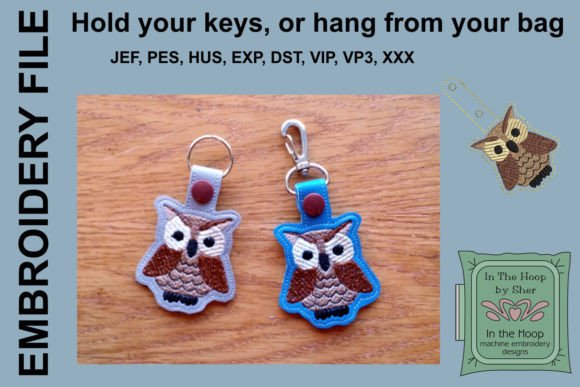
Reviewing Howard the Owl Key Fob for Business
As an embroidery designer who has spent years digitizing and testing designs for commercial use, I approach every new machine embroidery design with a critical eye. It is not just about whether the image looks cute on a screen; it is about how it performs under the needle, how it holds up after washing, and most importantly, how it serves the brand identity of the small business owner purchasing it. Today, I am reviewing Howard the Owl Key Fob, a digital asset that promises versatility for makers and merch creators.
This product is described as an embroidery machine file and instructions to make this owl key fob or bag tag with your embroidery machine. It comes with multiple embroidery file formats, which is a baseline requirement for any professional workflow. But does it deliver the quality needed for branded patches, uniform accents, and high-value handmade products? Let us dive into the details from a production standpoint.
First Impressions: Visual Personality and Brand Fit
The first thing I look for in a design like Howard the Owl Key Fob is its visual personality. Owls are a staple in the Birds category, often associated with wisdom, nature, and whimsy. In the context of Embroidery, an owl design can easily tip into being too cartoonish or overly complex. However, based on the intended use as a key fob or bag tag, this design appears to prioritize clarity and boldness.
For small business owners, particularly those in creative studios, bakeries, florists, or boutique retail, the aesthetic needs to strike a balance between friendly and professional. Howard feels approachable. It does not scream "corporate stiff," nor does it feel amateurishly chaotic. This makes it an excellent candidate for brands that want to project warmth and reliability. Whether you are running a pet brand or a local café, this design offers a decorative yet structured look that can enhance customer engagement without overwhelming the primary logo.
Real-World Applications for Small Business Merch
The true value of a digital embroidery file lies in its versatility. While the title suggests a key fob, I encourage designers and shop owners to think broader. Here is how Howard the Owl Key Fob performs in various commercial applications:
- Embroidered Patches: This is the most obvious use case. A well-digitized owl makes for a fantastic iron-on or sew-on patch. Patches are low-risk, high-reward items for small business merch. They allow customers to buy into your brand identity without committing to a full garment.
- Apron Embroidery: For bakeries and florists, branded aprons are walking advertisements. Placing Howard on the chest pocket or lower corner adds a touch of handmade charm. Ensure the stitch density is appropriate for frequent washing, as aprons take a beating in commercial settings.
- Cap Embroidery: Caps are tricky due to the curved surface. If the design is compact, it can work beautifully on the front panel or side. However, you must check the hoop size compatibility. A design meant for a flat key fob might need resizing or re-digitizing to sit correctly on a cap without distortion.
- Tote Bag Design: Canvas tote bags are a staple for boutiques and markets. Howard can serve as a central graphic or a subtle sleeve detail. The contrast of thread colors against natural canvas can create a rustic, premium feel that elevates the perceived value of the bag.
- Staff Uniforms: Adding a small embroidered motif to work shirts or polos can unify a team. It creates a sense of belonging and professionalism. Just be mindful of placement; a small owl on the sleeve or near the collar is often more elegant than a large center-chest print.
Technical Considerations and Production Notes
Before you load this embroidery file into your machine for a large batch order, there are several technical factors to evaluate. As a designer, I always advise running a test stitch-out on the actual fabric you intend to use. Fabric texture plays a huge role in the final appearance of any finished product.
Stitch Density and Detail: Key fobs are small. If the design has high stitch density, it may become stiff and bulky when scaled down. Check if the design maintains its integrity at smaller sizes. If you are using it for tiny lettering or detailed outlines within the owl’s features, ensure they do not merge together. On textured fabrics like terry cloth or heavy canvas, fine details can get lost. In such cases, simplifying the design or increasing the outline thickness might be necessary.
Thread Colors and Contrast: Review the default thread colors provided in the file. Do they align with your brand palette? If you are embroidering on dark uniforms, you will need to adjust the color sequence to ensure visibility. A printable mockup can help visualize these changes before you waste thread and stabilizer. Always test black and white versions first to check for contrast issues.
Stabilizer Selection: For a key fob or bag tag, stability is crucial. Use a cut-away stabilizer for items that will undergo stress, like keys jingling in a pocket. For woven fabrics on caps or shirts, a tear-away might suffice, but always consider the weight of the stitching. Improper stabilization leads to puckering, which ruins the professional look of your custom apparel.
Enhancing Brand Identity and Customer Trust
Why does a specific design matter for your business? Because consistency builds trust. When a customer sees Howard the Owl Key Fob on your packaging, your website, and your physical merchandise, it reinforces your brand identity. It signals attention to detail and a commitment to quality.
Handmade products thrive on uniqueness. Using a specialized machine embroidery design rather than a generic print sets your brand apart. It shows that you have invested in custom assets. This perception of effort increases the perceived value of your products. Customers are more likely to engage with and share products that feel personal and crafted, rather than mass-produced.
Furthermore, offering branded add-ons like key fobs or patches can increase average order value. They make excellent impulse buys at checkout or gifts with purchase. By integrating Howard into your broader suite of design assets, you create a cohesive visual language that resonates with your audience.
Where to Use Caution
While versatile, this design is not a one-size-fits-all solution. Be cautious when applying it to:
- Very Small Patch Sizes: If you shrink it too much, the intricate parts of the owl may not stitch out cleanly. Always respect the minimum recommended size.
- High-Stretch Fabrics: Without proper hooping and stabilizing, embroidery on stretchy materials can distort the design.
- Items Requiring Industrial Washing: If you are producing uniforms for a hospital or heavy industry, ensure the thread type and stitch structure can withstand harsh chemicals and high heat.
Final Verdict for Commercial Use
Howard the Owl Key Fob is a solid addition to the library of any embroidery professional or small business owner. It offers the flexibility needed for various applications, from commercial embroidery projects to individual handmade gifts. However, success depends on proper execution.
Before launching a product line featuring this design, confirm the commercial licensing terms. The description states it is an embroidery machine file, but always verify if there are restrictions on the number of physical items you can sell. Additionally, since the exact stitch count and specific hoop size recommendations are not detailed in the brief description, I strongly advise checking the included instruction file or contacting the creator for these specs. Knowing the hoop size is essential for planning your production workflow, especially if you are using multi-needle machines or specialized hoops for caps.
In conclusion, if you treat this digital embroidery file with the technical respect it deserves—testing fabrics, adjusting tensions, and choosing the right stabilizer—it can become a profitable and recognizable element of your brand. It is not just a picture of an owl; it is a tool for building connection and value in your small business merch strategy.